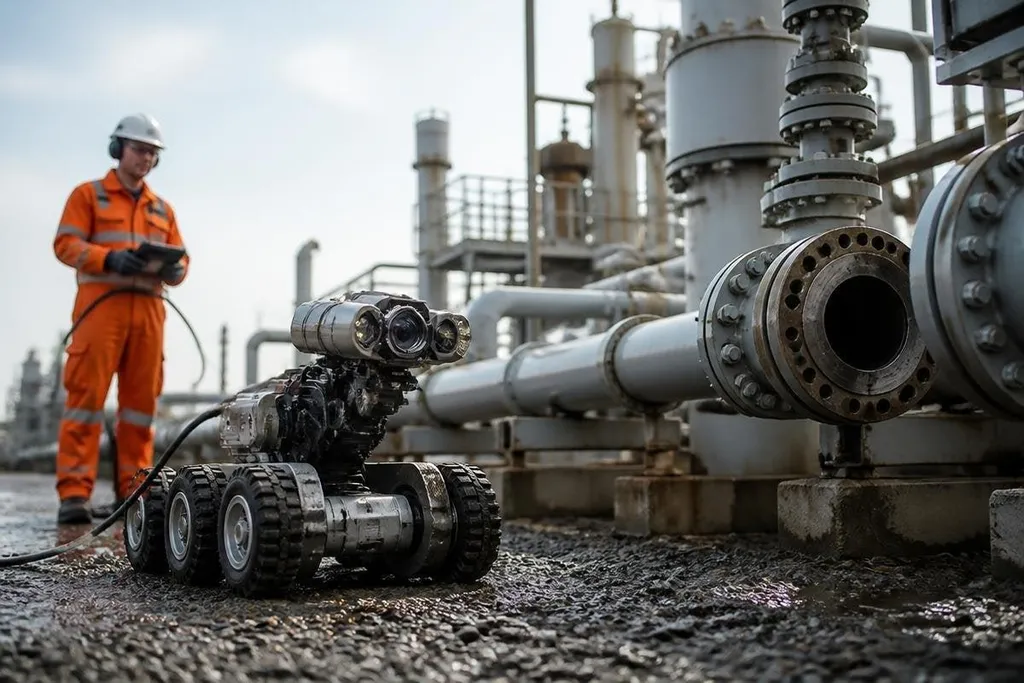
Oil and gas robots can inspect dangerous areas without sending a worker into the first line of risk. They can also fail through lost communications, poor sensor data, or a task they were never built to handle.
- Fewer people near leaks, heat, and moving equipment
- Better access to narrow or unstable spaces
- New risks from software, batteries, and false readings
Where robots help
These machines can carry cameras, gas sensors, thermal cameras, or ultrasonic tools into places that are hard to reach.
A remotely operated vehicle may inspect underwater equipment, while a crawler can move along pipes, tanks, or other steel surfaces.
That changes the job for the inspection team. A worker can guide the robot from a safer location, review its images, and decide whether a repair crew needs to enter the area. The robot does the first pass; people still make the call when the evidence is unclear.
Robots can also repeat the same route. A fixed camera may watch a valve area, while a mobile system checks several points during a scheduled inspection. Repeated checks can help teams spot a leak, damaged coating, or unusual heat before the issue becomes harder to manage.
The benefit depends on the sensor and the task. A camera can show a loose part, but it cannot measure every gas or confirm the strength of a pipe. The system must carry the right tool for the question being asked.
Oil and gas work turns a sensor choice into a safety question: the wrong detector can miss the gas the robot was sent to find. Use Robot24.com to check the machine, site, test date, and measured result before the next section looks at the risks that remain.
The risks robots introduce
A robot adds another system that can fail. Its battery can run low, its radio link can drop, or its wheels and tracks can lose contact with the surface. A machine that stops in a restricted area may create a recovery job for the same people it was meant to keep away.
The site itself adds limits. Oil and gas facilities may contain flammable gases, high temperatures, pressure, chemicals, and heavy machinery. A robot must have the right electrical design and site approval before it enters such an area. A normal commercial drone or inspection crawler may be unsafe there.
False readings are another concern. Dust, rain, glare, vibration, and a dirty lens can affect what a sensor reports. A clean-looking image does not prove that a pipe, tank, or valve is safe.
Software brings a separate risk. A connected robot may expose a path into site networks if operators do not separate its controls from other systems. Access rights, update rules, recorded data, and manual recovery steps need clear owners.
The work can change, too. Robots may reduce time spent on routine inspection, but people still need to plan missions, check data, repair machines, and respond when a result is uncertain. Training becomes part of the purchase, not a task to leave for later.
What to check before buying
The right question is not whether a robot looks capable in a demonstration. Ask whether it can complete one defined task at your site, with a clear recovery plan when the task fails.
- Define the task. Write down the area, surface, sensor, inspection result, and handoff to a human.
- Check site approval. Confirm the robot’s electrical design, operating limits, and access rules with the site safety team.
- Test the link. Measure how the robot behaves when communications weaken or disappear.
- Set a human check. Decide which readings need a second inspection before work continues.
- Plan recovery. Keep a safe method for removing a disabled robot without sending people into avoidable danger.
- Price the full system. Include training, spare parts, software support, data storage, and inspection time.
A pilot should use a real route and a real inspection question. Record missed areas, false alarms, battery stops, communication failures, and the time a person spends reviewing results. Those details matter more than a smooth demonstration.
The practical choice
Robots fit oil and gas work best when the task is repeatable, the danger is known, and the machine can carry the needed sensor. They fit poorly when the site changes quickly, the inspection depends on touch or judgment, or recovery would put people at risk.
I’d approve a robot after it proves one useful inspection under site conditions, not after a showroom demonstration.
The next purchase decision should rest on one written measure: what dangerous human entry the robot removes, and what new failure the team is ready to manage.